Queer Places:
Mount of Olives Cemetery, Jerusalem, Jerusalem District, Israel
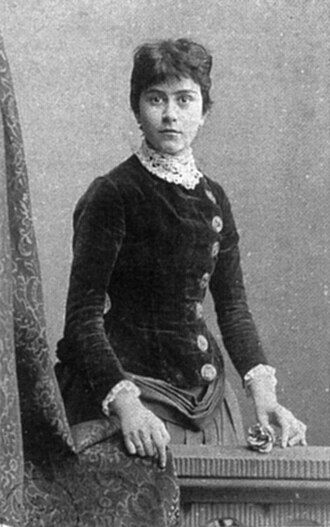 Else Lasker-Schüler (February 11, 1869 - January 22, 1945) was born Elisabeth Schüler on February 11, 1869, in Elberfeld, Germany, and grew up as a
recognized child prodigy who learned to read and write by age four. Her mother, Jeannette Kissing, deeply inspired her poetry, while her father, Aaron
Schüler, a Jewish banker, served as the inspiration for her play Die Wupper. Demonstrating an early brilliance, she attended the Lyceum West an der Aue
before continuing her education through private lessons at home.
Else Lasker-Schüler (February 11, 1869 - January 22, 1945) was born Elisabeth Schüler on February 11, 1869, in Elberfeld, Germany, and grew up as a
recognized child prodigy who learned to read and write by age four. Her mother, Jeannette Kissing, deeply inspired her poetry, while her father, Aaron
Schüler, a Jewish banker, served as the inspiration for her play Die Wupper. Demonstrating an early brilliance, she attended the Lyceum West an der Aue
before continuing her education through private lessons at home.
In 1894, she married physician and chess master Berthold Lasker, the brother of World Chess Champion Emanuel Lasker, and relocated to Berlin to train
as an artist. Although her mother passed away in 1890 and her father followed seven years later, her life shifted with the birth of her son, Paul, in
1899, and the publication of her earliest poems. Her debut poetry collection, Styx, was published in 1902. Following her divorce from Berthold Lasker in
1903, she married Georg Lewin, an artist and the founder of the Expressionist magazine Der Sturm, for whom she invented the pseudonym Herwarth Walden.
During this period in Berlin’s vibrant avant-garde, Lasker-Schüler pushed boundaries through fluid gender expression, cross-dressing, and non-conforming
sexual and romantic identities, famously adopting alternative personas such as the male prince "Yussuf" and serving as a close protégé and devoted
admirer of poet Peter Hille, whom she portrayed as a king-like, prophetic figure in her prose work Das
Peter-Hille-Buch (1906).
Lasker-Schüler established herself as a leading female voice of German Expressionism with prose collections like Die Nächte der Tino von Bagdad
(1907), her play Die Wupper (1909), and her seminal 1911 poetry volume Meine Wunder. After separating from Walden in 1910—ending in divorce in 1912—she
struggled financially and relied on friends like Karl Kraus, while also engaging in an intense, creatively fruitful friendship with Gottfried Benn that
yielded numerous love poems. Despite winning the prestigious Kleist Prize in 1932, the rise of the Nazi regime brought severe physical harassment and
threats due to her Jewish heritage. She fled to Zurich and later emigrated to British-ruled Palestine in 1934, officially settling in Jerusalem in 1937,
where she was stripped of her German citizenship in 1938.
In Jerusalem, she lived in relative poverty, facing hardship and local misunderstanding regarding her eccentric dress and behavior. She founded a
literary salon named "Kraal" in 1942, though her readings were eventually banned because they were conducted in German. Despite these struggles, she
completed her final poetry volume, Mein blaues Klavier (My Blue Piano), in 1943. Her health failed toward the end of World War II, and following a heart
attack, she died on January 22, 1945, at the age of 75, and was laid to rest in the Mount of Olives Jewish Cemetery.
References:
- Styx (1902) – Her first published volume of poetry.
- Der siebente Tag (1905) – Her second volume of poetry.
- Das Peter-Hille-Buch (1906) – Her first major prose work, dedicated to Peter Hille.
- Die Nächte der Tino von Bagdad (1907) – A collection of prose.
- Die Wupper (1909) – Her primary play.
- Meine Wunder (1911) – The poetry volume that established her as a leading voice of German Expressionism.
- Hebräische Balladen (1913) – A collection exploring biblical motifs and Jewish identity.
- Gesammelte Gedichte (1917) – A collected edition of her poetry.
- Mein blaues Klavier / My Blue Piano (1943) – Her final volume of poetry, printed in Jerusalem.
- Betty Falkenberg – Else Lasker-Schüler: A Life (McFarland, 2003) – The first full-length English-language biography of the poet.
- Ruth Schwertfeger – Else Lasker-Schüler: Inside this Deathly Solitude (Berg, 1991) – Includes a short biography alongside translations and analyses of her poetry.
- Frederic V. Grunfeld – Prophets Without Honour: A Background to Freud, Kafka, Einstein and Their World (Holt, Rinehart and Winston, 1979) – Features a dedicated biographical chapter on Lasker-Schüler.
- Avidov Lipsker – Red Poem/Blue Poem: Seven Essays on Uri Zvi Grinberg and Two Essays on Else Lasker-Schüler (Bar Ilan University Press, 2010).
- Audri Durchslag and Jeanette Litman-Demeestère (Trans.) – Hebrew Ballads and Other Poems (The Jewish Publication Society of America, 1980).
- Robert P. Newton (Trans.) – Your Diamond Dreams Cut Open My Arteries (University of North Carolina Press, 1982).
- Janine Canan (Trans.) – Star in my Forehead: Selected Poems (Holy Cow! Press, 2000).
- Brooks Haxton (Trans.) – My Blue Piano (Syracuse University Press, 2015).
- Else Lasker-Schüler Collection – Maintained by the Center for Jewish History, containing digitized letters, personal correspondence, postcard sketches, and drafts from her years in Berlin, Switzerland, and Jerusalem.
- Else-Lasker-Schüler-Archive – Located in Jerusalem, holding correspondence such as her letters to Rabbi Kurt Wilhelm.
Support this project
This website is a passion project researched, developed, and funded entirely by me. If you find the content valuable and would like to help support the ongoing research and hosting costs, any contribution is deeply appreciated.
Thank you for keeping this independent resource alive!
My books on Amazon: Elisa Rolle's books
BACK TO HOME PAGE